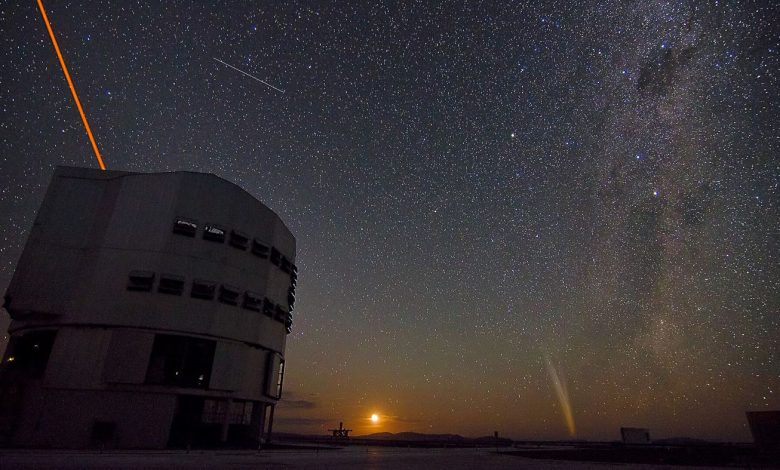
On remote mountaintops in Chile and Hawaii, engineers are assembling telescopes so large that their mirrors span tens of metres, gathering far more light than any telescope that came before them. These giants are designed to look back to the first galaxies that formed after the Big Bang, to watch planets being born around young stars, and to measure the expansion of the universe with new precision. Building them is an extraordinary challenge. Their mirrors are made of hundreds of segments that must be aligned to a fraction of the width of a human hair, and their domes must rotate smoothly while shielding the instruments from wind and dust. Adaptive optics systems, which flex a mirror thousands of times a second to cancel the shimmer of the atmosphere, let them see almost as sharply as telescopes in space. When they open their eyes, they will rewrite parts of the astronomy textbooks.
What the Evidence Shows
The new telescopes will work alongside space observatories rather than replacing them, each covering what the other cannot. Ground telescopes can be far larger and their instruments can be repaired and upgraded, while space telescopes enjoy a clear view above the atmosphere. Together they will study the atmospheres of distant worlds, searching for the chemical fingerprints of water and other gases, and trace how galaxies grew from small clumps of stars into the spirals and ellipticals we see today. They will also hunt for the faint light of the very first stars, which burned briefly and brilliantly before fading away. Construction is slow and expensive, and some projects have faced delays and budget debates, but the science case has kept them moving forward. The first of these giants should begin observing within a few years. Reporting and analysis from sources such as National Science Foundation track the same developments, and specialists following the giant ground telescopes peering into the early universe say the direction is now consistent across independent lines of evidence.
The Wider Context
The wider context is a research landscape in which replication and open data now decide reputations. Findings connected to the giant ground telescopes peering into the early universe are being checked by independent groups with shared datasets, and the teams involved publish their methods in full so rivals can test every step. That discipline is slower than a headline cycle, but it is why results in this area increasingly survive first contact with scrutiny.
What Happens Next
What happens next in the story of the giant ground telescopes peering into the early universe will be decided by follow-up work already under way: larger samples, longer observation and instruments that have not yet come online. The researchers involved are unusually united on one point, that the current results justify the next investment of time and money. Readers will not have to wait long for the first tests of that claim. You can follow related developments in our coverage of science.
There is a practical lesson in all of this for readers deciding what to do today. Start with the verified facts, be wary of anyone promising certainty, and prefer reversible steps while the evidence is still developing. Circumstances differ by country, income and personal situation, so general guidance should always be weighed against your own context before you act on it in any significant or lasting way.